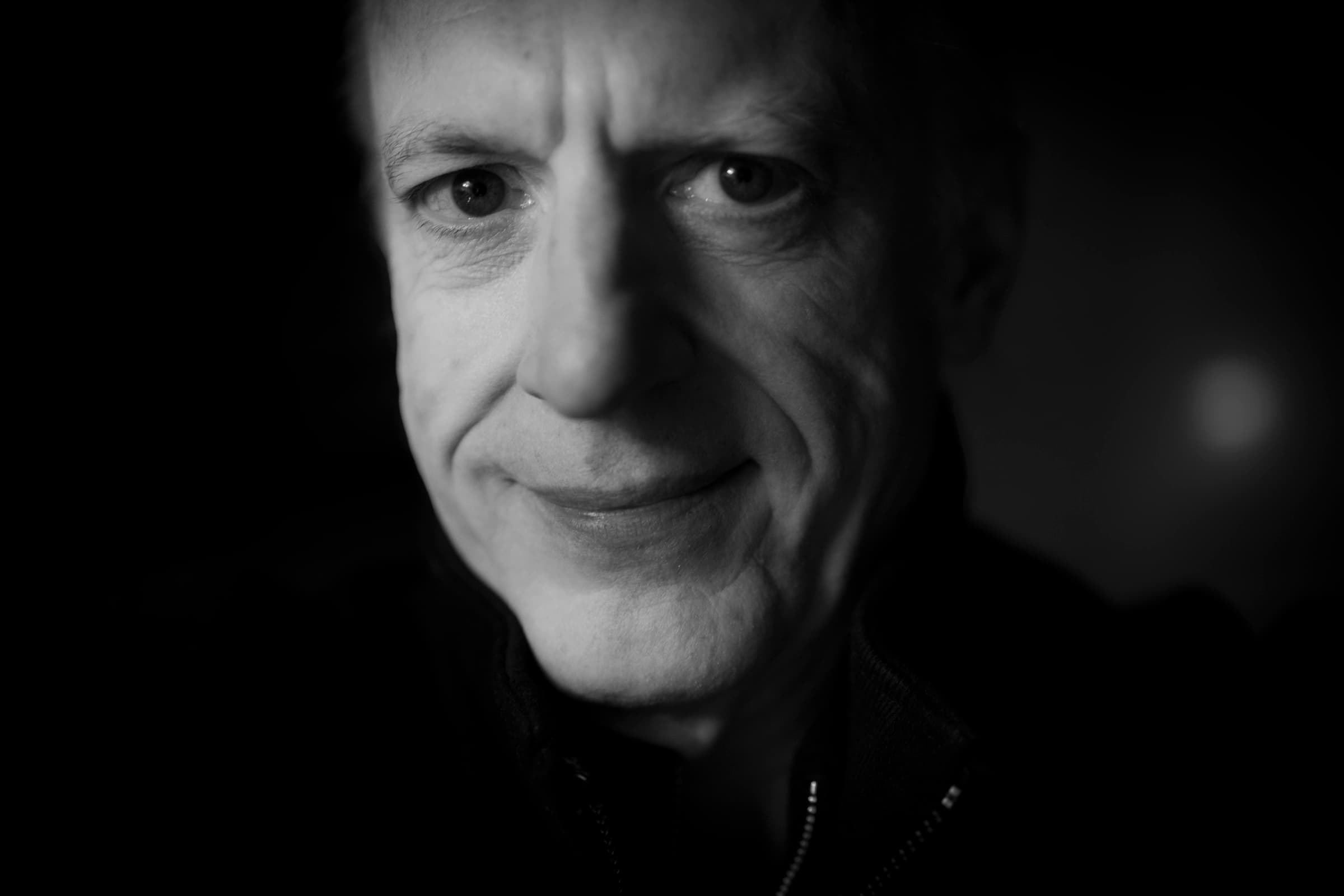
Mike Fullerton
Software Architect
I have been writing software in the Apple ecosystem since AppleSoft Basic. I spent years building things at Microsoft and Apple, and I haven't stopped since. More on my LinkedIn profile.
I live in Silicon Valley.
Experience
For eleven years I worked on Messages at Apple, across iOS, iPadOS, macOS and watchOS. I built the client-side architecture that Tapbacks, stickers and the features after them were built on, and I worked on every layer of a product roughly a billion people use each day: SQLite schemas and persistence, peer-to-peer protocols, daemons and XPC, and the interface on top. I built the Messages SQLite test harness, an early continuous integration system and the team's daily build tool, which made a data layer that size safe to keep changing. I set technical direction for the team and led its architecture and design reviews.
Before I returned to Apple, I ran my own software business for five and a half years, where I built FishLamp, an open-source Objective-C framework that shipped in three commercial titles. I also led PayPal's iOS team and built the shared framework behind its Bluetooth in-store payments.
Before that I spent eleven and a half years at Microsoft. As development lead for Entourage, now Outlook for Mac, I built its IMAP, POP3 and SMTP engines, the cooperative multithreaded networking layer beneath the whole application, and the contact preview panel Steve Jobs demonstrated at a Macworld keynote. For Hotmail and Windows Live I built a protocol server with full IMAP and POP3 support, backed by SQL Server, for hundreds of millions of users, with a generator that made the database schema the source of truth. Agentic Developer Hub is built the same way.
Before Microsoft, I spent my first years at Apple on MacApp, Apple's application framework, where I built its first reusable networking subsystem, the layer the commercial Mac software of the time was written against. I'm a co-inventor on seven granted US patents, one at Apple and six at Microsoft.
Entrepreneur
What it's all for
Everything I'm building, the companies and the products below, is in service of one piece of software: a digital assistant that helps people with ADHD manage their time and their lives. I've had the idea for years, and only recent advances in AI have made it possible to build.
Olylo
Olylo is an early prototype of the front end for the assistant's AI persona. It isn't hooked up to the backend yet. That's coming soon, and I'm working on it now.
My Companies
FishLamp Design

FishLamp Design is my company. It creates software for consumers.
Agentic Development Studio
Agentic Development Studio is a company owned by FishLamp Design. It creates software for developers and offers development services: building and repairing apps, website and backend development, consulting and contracting, and teaching development teams how to use AI to write software well.
Products
Agentic Development Studio's products for developers.
Agentic Developer Hub

Agentic Developer Hub is a backend platform for software built with AI agents. One service in front of a PostgreSQL database holds everything, and every other part is a client of it: a REST API generated from the database schema, an MCP server for agents, SDKs, a sync daemon that keeps a working copy on each device, and a website for the Hub and one for each of its features. Each product built on it keeps its own users, storage and billing behind a boundary the database enforces, and who may see or do what is decided in code, never by a model. It provides accounts, sign-in and billing, along with flexible storage, notes and research. It hosts AI personas with agentic memory and knowledge bases in a vector database, and chat between people and personas. It also has community forums, project tracking and integrations. It runs on Apple platforms, Android and Windows, with models from many providers.
The Agentic Developer Team

The Agentic Developer Team is a deterministic multi-agent team harness for reviewing, fixing, planning and building software. Its engine runs the team: it sequences the stages, holds the state of each run, keeps the agent that does the work apart from the agents that verify and score it, and decides in code when a loop stops, so no model can call its own work finished. The models do only the work inside a stage, from prompts kept as data. Its specialists each review a change through one lens, such as security, architecture, data or accessibility, and the team fixes what they find. Given a plan, it turns the plan into checkable criteria and builds toward them one revertible step at a time. It works with models from many providers, and it runs on Apple platforms, Android and Windows.
Agentic Persona Registry

Agentic Persona Registry is a public registry of AI personas. Owners build their personas in Agentic Developer Hub and choose which ones the registry lists. Each persona has a permanent address and a profile with its character, voice, examples, reputation and the model it runs on. A visitor can search for personas by what they offer and talk to one without an account, within cost limits and with every message screened. It runs on the web and on Apple platforms, Android and Windows, and lists personas built on models from many providers.
BitBag

BitBag is Agentic Developer Hub's AI persona for developers. Like any Hub persona, it is a prompt, a voice and a character with memory and a knowledge base, and it speaks through an animated avatar drawn by a separate engine that can draw any persona's face. It knows the Hub, FishLamp Design, me and every tool the studio makes, along with a curated timeline of what matters in agentic development, and it answers only from what it knows and says so when it does not. It runs on the web and on Apple platforms, Android and Windows, on whichever model and provider it is given.
Agentic Developer Cookbook
 Agentic Developer Cookbook
 is a library of reference documents that agents read before they write code: principles, guidelines, and recipes precise enough that two implementations of the same recipe behave alike. It has no runtime. Every document is markdown with a stable address and a version, and a compiler turns each one into a skill that any agent host can load, tuned for each host and model. Because each document is its own skill, an agent loads only the guidelines for the work in front of it. It covers planning, building, testing, reviewing and shipping software, as well as research, brainstorming and writing, with compliance checks for security, accessibility, privacy and reliability. Its recipes specify native components for Apple platforms, Android, Windows and the web, and it works with agents on models from many providers.
Stenographer

Stenographer records the sessions of the coding agents a developer works with. One background service captures each session's events and transcript into a database on the developer's own machine, and everything else is a client of that service: the app, the command line, the status line and the usage widget read the same records, so they show the same numbers. From those records it shows live sessions with summaries, conversations across sessions, quota and cost for each account, charts and statistics, and answers to questions asked of the developer's own data. Oversight rules, kept as data, watch running sessions and act on them, and a router spreads an agent's requests across the developer's accounts. It can send routine work to a smaller model, but it never substitutes a stronger model than the agent asked for. It also tracks working time by project, with billing rates. Its AI features run on models from many providers, local ones included. For now Stenographer runs on macOS only, and it can sync across devices through Agentic Developer Hub if the developer turns that on.
Agentic Developer Kitchen

Agentic Developer Kitchen is a macOS app for building software in partnership with AI models. Each project is a git repository with its own window, split into tabs and panes that reopen as they were left: files, a code editor with language servers, terminals, a web browser, notes and chat. A model can work in a terminal as a persona, and it can drive the browser panes through the app's own MCP server. Chat uses the Claude Code command line already on the Mac, and the Anthropic API, OpenAI, Google's models, local models or any OpenAI-compatible server can be added. It runs Visual Studio Code extensions and installs them from Open VSX. It records Claude Code sessions and conversations, and its AI oversight watches live sessions, including how full each one's context window is. It can be themed and scripted with AppleScript. It is still in development.
Musician
I've been a musician my whole life. Playing the drums is one of my three longest relationships (first is my mother, second is my sister). It's part of who I am. Listen to my band Scratchy Fish.